

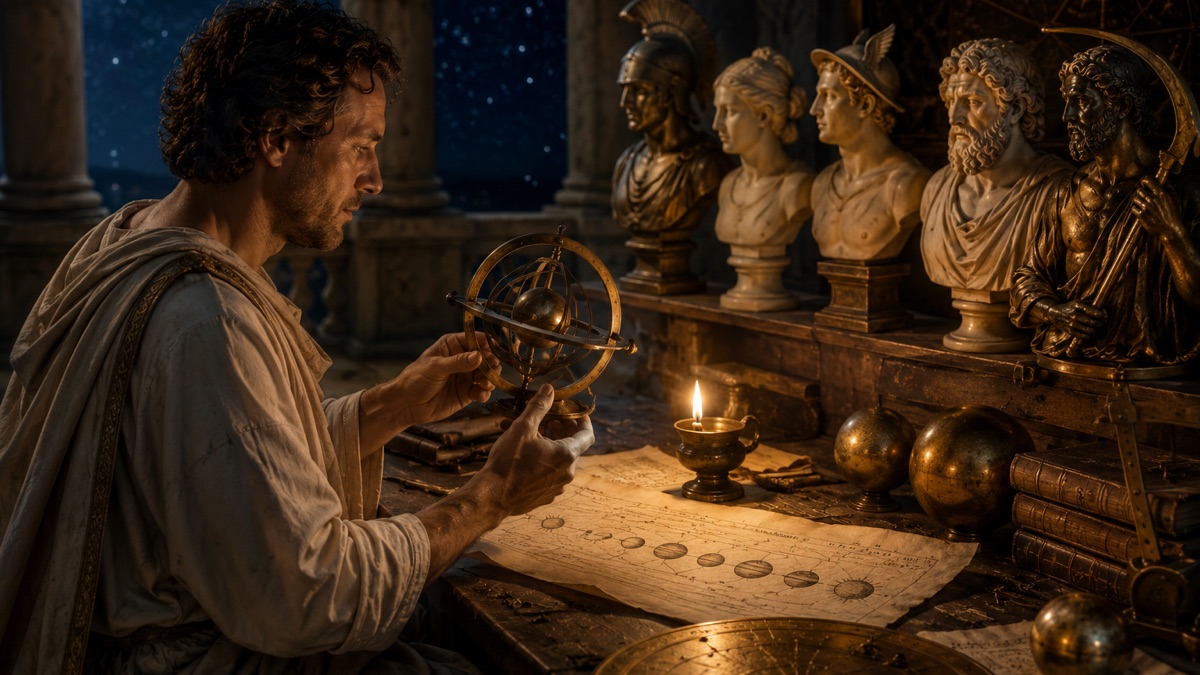
Every sign has a "ruling planet" — Mars for Aries, Venus for Taurus, the Moon for Cancer — and the pairing isn't arbitrary. Ancient astronomers assigned each planet to the sign whose temperament best matched the god or character it was named for, and the system has barely changed since.
The classical seven
Before telescopes, only seven bodies moved independently against the fixed stars: the Sun, the Moon, Mercury, Venus, Mars, Jupiter, and Saturn. Each one ruled at least one sign — fiery Mars for Aries, steady Saturn for Capricorn, quick Mercury for Gemini and Virgo, warm Venus for Taurus and Libra. The Sun ruled Leo. The Moon ruled Cancer. Everyone else split a planet between two signs.
The modern three
Uranus, Neptune, and Pluto weren't visible to the naked eye, so they entered the system centuries later — once telescopes found them, astronomers gave each one to a sign whose temperament matched its discovery: unpredictable Uranus to Aquarius, dreamy Neptune to Pisces, transformative Pluto to Scorpio. Both the old and new rulers still apply to those three signs.
What it means for your ritual
Your ruling planet isn't a separate thing to learn — it's already baked into your sign's page, part of what shapes the specific way your 7-minute flow moves. Mars-ruled Aries gets rooted stances for unspent drive. Saturn-ruled Capricorn gets structure built for rest. The planet was never the point. What it does to your body is.